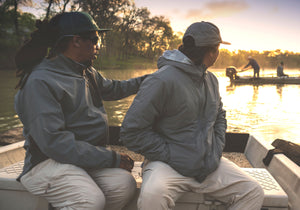

Make the best out of a day on the water.
Guest post by Mark Roberts, Orvis Endorsed Guide
A deep pool, a silver shimmer, a flick of an arrow shaped tail. That’s all it takes to get my attention. I stop and crouch low, allowing my eyes to pierce through the depths. I know they are there, yet they do not give themselves up easily.
Grayling are born survivors, utilising ‘active camouflage’ and shoaling to keep as safe as they possibly can. It’s down to me to be as prepared as I possibly can, to push the odds in my favour.
I have been fortunate to catch some big Grayling over the years and in each instance, preparation was the most important factor for success; along with a massive amount of fisherman’s luck!
It’s not all about size and numbers though. Just one fish is perfect, two would be the icing on the cake and sometimes they just keep coming in waves that satisfy our need for a dopamine high.
Throughout the hot summer months, I lost track of the number of times that a single Grayling avoided the dreaded skunk for a client and I found myself repeating “they don’t need to be big, they just need to be beautiful”. Guess what? They always are!
There are so many great sources of information out there about hunting the Lady of the River. The seminal books of Steve Skuce and John Roberts to name just a few but nothing beats time on the water and learning about what makes these gorgeous creatures tick.
I love Grayling! There, I have said it. They are my primary fish of choice, and I challenge anyone to dismiss the glorious Grayling on any river, in any country.
Here I have tried to distil a few of my personal ‘go to’ strategies that may be useful to anyone heading out on a cold frosty morning to hunt for the perfect quarry.

Tip 1: Pay attention to your leader
Setting up your leader to help you rather than hinder you is right up there on my list.
- Break out a new Orvis Super Strong 12ft tapered leader. 5x is perfect.
- Copolymer or Fluorocarbon? Your choice but I tend to stick with Copolymer on the chalk. Fluorocarbon when I know there are rocks and obstructions below the surface.
- Run the leader through your fingers to straighten it, the residual heat from your hands is more than enough to break the polymer bonds and reduce the spiral kinks that have formed in the packet.
- Dry Fly: Add Orvis Hy Flote Gel all the way along the leader, from the fly to the fly line.
- Nymphing: Add Fullers Mud along the leader to aid the sink rate.
- Avoid letting your leader become too short, add Orvis Super Strong tippet when needed and check for knots and rough abrasions regularly.
Tip 2: Small and heavy or just small?
Grayling love aquatic nymphs and feed lower in the water column than their distant cousin Salmo trutta. Find out what the predominant nymph species is on your river and stock your fly box with different sizes and weights.
Don’t forget that they love a dry fly too and are quite happy to hit a fly on the surface on a winter’s day.
- My go to nymphs are Cased Caddis patterns, Pheasant Tail Nymphs and shrimps.
- Sizes: My primary size is #16 down to #20. Have a few in a #10 and #12 for those just in case moments.
- Avoid ignoring the well-established patterns that work. The ‘next best thing’ that appears on social media is not always the panacea that you think it is.
- For a dry fly: An Elk Hair Caddis in #16 or #18

Tip 3: Strike indicators are your friend
Spotting when your nymph has been intercepted can be extremely difficult. For every successful fish you make contact with you have missed far more than you know.
- Strike indicators come in lots of different shapes and sizes. I like to add Orvis Tri Colour Tactical Sighter as part of my leader set up or I use the New Zealand Strike Indicator
- Where you are allowed – utilise a dry dropper set up.
- Avoid ignoring the benefits of strike indicators.
Tip 4: Eyes on the prize
Observing the water and being able to look deeper into the depths allows you pinpoint fish you might have missed.
- A good set of polarising sunglasses are worth their weight in gold.
- My preference is for glasses by Smith Optics
- Avoid glasses that don’t sit around the side of your eyes, the extra reduction in light will really make a difference.
Tip 5: Weapon of Choice
Choose your rod and line to fit the river you are going to fish.
- A longer rod than normal is going to allow you to keep in contact with your fly. The Orvis Recon 10ft 3 weight is the perfect companion for a day on the river.
- Match it up with the Orvis Pro Trout Line – Smooth in a 3wt to get the best out of the rod.
- Avoid a short rod – time to leave the 8ft rod at home
Final Thoughts
These tips aren’t exhaustive by any means but by paying attention to your leader and fly set up as a priority you will improve your catch rate and enjoy your time on the water.
Don’t forget to stay warm too!
If you want to find out more why don’t you book a Catch Series: Chalk Stream Grayling Experience with me and the Orvis Guiding team this winter.
