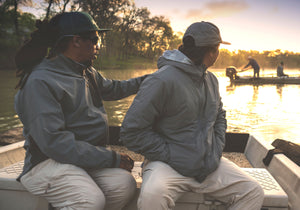

This report brings together the experiences of Tom Barclay and Neville Broad, two anglers who have fished together regularly since first meeting at the UK Saltwater Festival in St Mawes in 2019. What began as a shared session at that event developed into a long standing friendship built around a love of saltwater fly fishing and travel, in particular to one special place: Norway.
Norway’s Arctic fjords offered the chance to put the new Recon through a proper field test, fishing deep water, heavy lines and strong saltwater fish.

Tom: Deep water, heavy lines and early testing of the new Recon
I have travelled north of the Arctic Circle into Norway twice, both trips centred around saltwater fly fishing from a boat in the fjord systems.
You are often fishing tight to steep structures where the depth increases almost immediately. September worked well on both trips. Air temperatures were cool enough for long days on the water, and angling pressure was minimal. Daylight hours were still generous, and weather windows were generally stable.
On the most recent trip, I was fortunate to spend time fishing a then unreleased Orvis Recon rod. Fishing from a boat in fjords, where the seabed drops away quickly beneath you, gives clear feedback on how rods, lines and reels perform when you are lifting heavy lines and fighting fish directly below the boat.

Both trips were shared with Neville, and fishing alongside him added a useful reference point throughout. Watching how he approached each drift, how he read the water, and how quickly he adjusted once a fish was hooked was a constant learning.
One of his phrases stuck early on: the “nodding cod”. Cod rarely make long, fast runs. Instead, they sit deep and use their weight, applying steady resistance rather than speed. On the rod, this shows up as a slow, rhythmic nodding of the tip as the fish holds deep. Once you have felt it a few times, it becomes immediately recognisable.
 |
 |
The most recent September trip introduced a different test in the form of large coalfish. They are faster and more aggressive than cod and tend to run hard across the tide once hooked. I was fishing the Orvis Recon 11 weight, paired with a Mirage VI reel and a 550 grain Depth Charge line. The Recon handled this well, particularly when lifting heavy line from depth and controlling fish that refused to come straight up. It had enough backbone to apply pressure without feeling stiff or unresponsive, which made longer fights far more manageable.
When coalfish made long, sideways runs, the Mirage VI’s drag remained smooth and consistent, even under sustained load. There was no hesitation or sudden change in pressure, which helped keep control during unpredictable changes in direction. The setup felt balanced, and nothing in the system ever seemed close to its limit, even with strong fish in moving water.

The earlier trip focused almost entirely on cod. These were large, solid fish that relied on weight and stubbornness rather than speed. For that trip, I fished an Orvis Helios 11 weight with the same 550 grain Depth Charge line. It was a well suited combination for deep water and heavy flies, allowing steady pressure to be applied without feeling out of its depth when a fish decided to sit tight on the bottom.
Two trips that left a lasting impression. Neville’s story stretches further back, shaped by more than a decade of fishing Norway’s saltwater from south to far north.
Neville: Tactics and lessons from over a decade fishing Norway’s saltwater
I love the fact that you can fish in Norway and not see another soul for hours. The further north you get generally the more fish abound. It’s possible to fish off beaches, cliff slopes and ledges, and of course from a boat. There are also many fishing lodges making hiring a fishing boat and staying overnight stress free. My Norwegian saltwater fly fishing exploits started in June 2011 when I fished the Sotra region of Bergen.
I had some great sport on feisty mackerel (some nudging 3lbs) which were epic on a 5 wt outfit, but also on resident pollock that stalk prey along cliff drop offs. During those early trips it was obvious that a fast and long sinking set up were needed to get the fly in the taking zone of the beautiful red cod that frequent those western outer fjords in Norway.

I had to head further north, into the Arctic region, to get some truly amazing sport on the fly with the chance of a halibut. I was fortunate to use the guiding services of Jonny Stephenson of Wild Pursuits Guiding around the Troms region, and in the autumn of 2021, I broke the fly caught Norwegian halibut record which (at the time of writing) stands at 164.5cm and was an estimated 130lbs. The ability to throw a large streamer using a good haul of heavy tungsten shooting head attached to an Orvis Depth Charge 550grains fly line with a 12wt outfit was key as the drift can be fast and you need to keep up in touch with the fly, stripping it back. It was exhilarating to actually see the halibut turn on its side and take the large pink streamer about ten feet in front of me. That was the start of an epic battle that lasted 30 minutes. She was safely released and hopefully lives to give another lucky angler their experience of a lifetime.

Photography credit to Stina Didrikson
In recent years I have been fishing further north with Tom around the Loppa region outside of Alta. I have consistently caught good sized cod and coalfish on the fly there and believe me a decent coalie will give you an amazing fight.
A main tactic is to cast either a large flatwing style pattern (e.g. a launce imitation) or an extra heavy weedless Clouser that I tie especially for Norway to get down quickly (see picture). Favourite fly colours are green or pink.

Avoid anything deeper than 30 metres for cod on the fly when boat fishing as you need to get the fly on or just above the bottom, which can be difficult to control on a drifting boat. Coalfish can lie at any depth, so find them on the sounder and make a judgement if you can get down to them with your set up. We have bumped up big fish to 550grains Depth Charges fly lines connected to T17 or T20 shooting heads.
If you want to learn more about fly fishing in Norway, you can find me on Instagram @nevbroadswff and I will be attending this year’s Orvis Saltwater Fly Fishing Festival so do reach out for a chin wag.